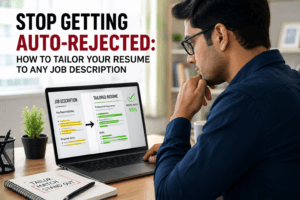

You found a job posting that looks perfect. The title feels right, and the company sounds exciting. So, you copy-paste your resume, hit apply — and never hear back.
Sound familiar?
Here’s the truth most job seekers don’t want to hear: the problem usually isn’t your experience. It’s that you never properly decoded what the employer was actually asking for.
Learning how to analyze a job description for skills is one of the highest-leverage things you can do as a job seeker today. It’s the difference between a resume that passes AI screening tools and one that gets filtered out in under six seconds. More importantly, it’s the difference between walking into an interview confidently versus winging it and hoping for the best.
In this guide, we’re breaking down a clear, repeatable process to extract must-have skills from any job description — and showing you how Jobuai’s free Job Mirror™ Mock Interview feature turns that analysis into real interview confidence.
Let’s get into it.
Why Analyzing a Job Description Is No Longer Optional
Before we get into the how, let’s talk about the why — because the hiring landscape has changed dramatically.
Over 75% of resumes are now screened by Applicant Tracking Systems (ATS) before a human ever reads them. These systems don’t care about your formatting. Instead, they scan for keyword matches between your resume and the job description. No match? You’re out.
However, it goes beyond ATS. Hiring managers spend an average of just 7 seconds on an initial resume review. In fact, they’re looking for signals — specific skills, tools, experiences — that show you’re the answer to their problem.
Moreover, in the interview room? The questions you’re asked are almost always built directly from the job description. Responsibilities become situational questions. Required qualifications become competency-based prompts.
As a result, analyzing a job description for skills isn’t just smart career strategy— it’s table stakes in modern hiring.

Step 1: Read the Full Job Description Once — No Highlighting Yet
At first, this may sound counterintuitive, but resist the urge to immediately start underlining keywords.
Your first read-through should be about context. What is the company’s actual problem that this role is solving? What does success look like in the first 90 days? What’s the culture signal hidden in the language they use?
A job description that says “you’ll thrive in ambiguity” is telling you something very different from one that says “you’ll follow established processes”. A company that uses words like “hustle”, “scrappy”, or “ownership mentality” is communicating a startup culture where initiative and speed are valued above polish and process.
First, read the whole thing. Then notice how it makes you feel. After that, go back for the detailed analysis.
Step 2: Separate Must-Haves From Nice-to-Haves
Additionally, in most cases, job descriptions are divided into two types of requirements, though they’re not always labelled clearly. Your job is to sort everything into two buckets:
Bucket 1 — Non-Negotiable (Must Have)
These are skills the employer considers baseline for the role. They typically appear under headings like “Requirements”, “Qualifications”, “You Must Have”, or “Essential Skills”. If you’re missing these, your application faces an uphill battle. Be honest with yourself.
Bucket 2 — Preferred (Nice to Have)
These appear under headings like “Preferred”, “Bonus”, or “Would Be Great If”. Employers post these as stretch goals — meeting even 60–70% of them still makes you a strong candidate.
Pro tip: If a skill appears in both sections, or shows up more than once anywhere in the posting, it is a high-priority signal. Make sure your resume and interview answers speak directly to it.
Step 3: Extract and Map Hard Skills to Your Experience
Hard skills are the concrete, teachable, and measurable competencies a role requires — software tools, technical certifications, programming languages, platforms, or domain-specific knowledge.
Next, go through the job description and pull out every hard skill mentioned. Then create an honest skills gap map:
- Strong match — You have this skill and can back it up with results
- Developing — You have basic exposure but aren’t fully confident yet
- Gap — You don’t have this skill yet
For strong matches, plan specific examples you’ll use in interviews.If you’re still developing certain skills, think about how you’d frame honest growth.Meanwhile, for gaps in must-have requirements, consider whether a quick upskill before applying is realistic.
As a result, this exercise will significantly sharpen your resume and help you stand out from most applicants.
Step 4: Decode the Soft Skills Hidden in Plain Sight
Soft skills rarely show up as bullet points labeled “Soft Skills Required”. Instead, they’re embedded in the job description’s language — and most applicants miss them entirely. Here’s a quick decoder:
Common Job Description Phrases Decoded
| What the JD Says | What They Actually Mean |
|---|---|
| Fast-paced environment | High pressure tolerance, adaptability, quick decision-making |
| Cross-functional collaboration | Stakeholder communication, relationship-building, diplomacy |
| Data-driven mindset | Analytical thinking, comfort with metrics, evidence-based decisions |
| Customer-first approach | Empathy, service orientation, patience under stress |
| Self-starter | Initiative, ability to work without constant direction |
| Strong communicator | Written clarity, presentation skills, active listening |
Additionally, for each coded soft skill you identify, think of a story from your past that clearly demonstrates it. The STAR method (Situation, Task, Action, Result) works perfectly here. These stories become your interview gold.
Step 5: Run a Keyword Frequency Check
Importantly, keywords that appear multiple times in a job description aren’t accidents — they’re priority signals. Manually, you can paste a job description into any word frequency counter to see which terms appear most often. But this takes time, and time is something most job seekers don’t have when applying to multiple roles.
That’s exactly where AI-powered tools change the game. Jobuai’s platform automatically extracts, weights, and surfaces the most important skills from any job posting — so you can focus your energy where it matters most.
Finally, once you identify your priority keywords, make sure they appear naturally in your resume summary, skills section, and work experience bullets. Naturally is the key word — keyword stuffing doesn’t fool modern ATS systems and makes your resume unreadable to humans.
Free Tool: Turn Your Analysis Into Interview Confidence With Job Mirror™
Extracting skills from a job description is only half the battle. The other half? Being able to speak to those skills confidently when you’re sitting across from a hiring manager.
This is exactly where Jobuai’s Job Mirror™ — Mock Interview feature comes in — and it’s completely free to use.
How Job Mirror™ Turns Analysis Into Action
Here’s how it works:
- Paste the job description into Job Mirror™
- The AI analyzes the role — identifying must-have skills, experience expectations, and likely interview themes
- You receive tailored mock interview questions built specifically around that job’s requirements
- You practice your answers and get real-time feedback on how well your responses reflect what the employer is looking for
Think of Job Mirror™ as having a career coach who has already read the job description, mapped out exactly what the interviewer will focus on, and designed a personalized rehearsal session just for you.
The difference in interview performance for candidates who practice this way versus those who don’t is night and day. When you’ve already answered the likely questions out loud — not just thought about them in your head — you show up calmer, sharper, and far more memorable.
Putting It All Together: Your 15-Minute Job Description Analysis Routine
Here’s the streamlined routine you can complete in under 15 minutes before applying to any job:
- Minutes 1–3: Read the full job description for context and tone
- Minutes 4–6: Sort all skills into must-have vs. preferred buckets
- Minutes 7–9: Map hard skills against your experience — identify your top three matches and any critical gaps
- Minutes 10–11: Decode soft skill requirements hidden in the language
- Minutes 12–13: Note the highest-frequency keywords for your resume
- Minutes 14–15: Paste into Jobuai’s Job Mirror™ and review your tailored mock interview questions
That’s it. Fifteen focused minutes that most of your competition simply isn’t doing.
Why This Skill Gives You a Competitive Advantage
The modern hiring process is competitive, fast, and increasingly AI-filtered. But that same shift toward AI has created powerful tools for job seekers who know how to use them.
Mastering how to analyze a job description for skills gives you a clear, repeatable advantage — one built not on luck or who you know, but on strategy and preparation. When you know exactly what a role demands, you can tailor everything: your resume, your cover letter, your interview stories, and your overall positioning.
And when you combine that analysis with Job Mirror™ AI-powered mock interview practice, you’re not just applying for jobs anymore. You’re engineering your way into them.
Ready to stop guessing and start getting interview calls?
Ultimately, all of this comes down to one thing: preparation.
Try Jobuai’s Job Mirror™ for free and instantly analyze your next job description with AI — before you apply.
FAQ’s
A. Read the job description once for context, then separate must-have and preferred skills. Extract key skills, map them to your experience, and identify gaps. Tools like JobUAI’s Job Mirror™ can automatically extract and highlight these skills in seconds.
A. Tools like JobUAI’s Job Mirror™ help analyze job descriptions, extract skills, and prepare you for interviews. It not only identifies key requirements but also helps you practice real interview questions.
A. Look for repeated skills, tools, and responsibilities in the job posting. These are important keywords. You can also use AI tools like JobUAI to automatically extract high-priority keywords and improve your resume.
A. You don’t need 100% of the skills. If you match around 60–70% of the requirements, you can still apply. Focus on transferable skills and show your willingness to learn during interviews.
A. Customize your resume for each job by adding relevant keywords, highlighting matching skills, and showing measurable achievements. JobUAI can help compare your resume with the job description and suggest improvements.
A. Use the job description to predict interview questions. Convert responsibilities into possible questions and practice answers. JobUAI’s Job Mirror™ does this automatically by generating role-specific mock interview questions.
A. Yes, AI tools can save time and improve accuracy. Platforms like JobUAI help with resume optimization, skill extraction, and interview practice, giving you a better chance of getting shortlisted.