
Congratulations on completing your studies! Now, you are stepping into the professional world—a phase that brings both excitement and uncertainty.
However, getting your first job is not just about having a degree. You also need the right plan, skills, and confidence to stand out.
In this guide, you will learn simple and practical tips to help you start your career successfully.
1. Build a Smart Job Search Strategy
Before applying for jobs, take some time to plan.
Start with Self-Assessment
First, understand yourself better:
- What are your strengths?
- Which roles interest you?
- What kind of work environment do you prefer?
Once you know this, you can apply for the right jobs instead of applying everywhere.
Use the Right Platforms
Next, explore multiple job sources:
- Job portals like Naukri, Indeed, and LinkedIn
- Company career pages
- College placement cells
- Alumni networks
In addition, LinkedIn is very important. Keep your profile updated and connect with professionals regularly.
2. Create a Strong Fresher Resume
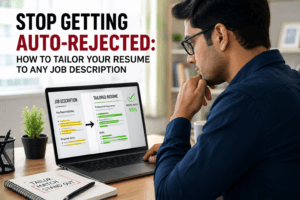
Your resume is your first impression. Therefore, it should be clear and easy to read.
What to Include
- Contact details (with LinkedIn profile)
- Career objective (customized for each job)
- Education details
- Projects and achievements
- Skills (technical and soft skills)
- Certifications and activities
Mistakes to Avoid
- Using the same resume for every job
- Adding too much unnecessary information
- Ignoring grammar and formatting
- Listing tasks instead of achievements
Instead, focus on what you achieved and what you learned.
3. Prepare for Interviews Effectively
Once you get shortlisted, the next step is the interview.
Know the Interview Process
Usually, interviews include:
- Screening round (basic questions)
- Technical round (skills and knowledge)
- HR round (personality and fit)
How to Prepare
To perform well:
- Practice common questions like “Tell me about yourself”
- Understand your projects clearly
- Research the company
- Prepare questions to ask
Moreover, mock interviews can help you improve confidence and communication.
4. Salary Negotiation for Freshers
Talking about salary can feel uncomfortable. However, it is an important part of the process.
Do Your Research
Check salary ranges using:
- Glassdoor
- AmbitionBox
Simple Tips
- Ask for the salary range first
- Give a realistic expectation
- Explain your skills clearly
- Consider benefits like bonuses and insurance
Even if salary is fixed, you can still ask about growth opportunities.
5. Your First 90 Days at Work
Getting the job is just the beginning. Now, focus on performing well.
Days 1–30: Learn
At the start:
- Understand company processes
- Learn tools and systems
- Build relationships with teammates
Days 31–60: Contribute
After that:
- Take small responsibilities
- Ask useful questions
- Take feedback seriously
Days 61–90: Grow
Finally:
- Work independently
- Suggest small improvements
- Prepare for performance reviews
Tips for Freshers to Succeed
- Stay consistent
- Keep learning new skills
- Improve communication
- Be proactive
- Stay positive
Common Mistakes to Avoid
- Applying randomly
- Not networking
- Poor interview preparation
- Low confidence
- Ignoring feedback
By avoiding these mistakes, you can improve your chances of success.
Starting your career may feel challenging at first. However, with the right approach, you can succeed.
Focus on learning, stay consistent, and keep improving. Eventually, your efforts will lead to great opportunities.
FAQ’S
A.Freshers should focus on learning workplace skills, understanding company processes, improving communication.
A.Freshers can make a good first impression by being punctual, dressing professionally, maintaining a positive attitude.
A.Common mistakes include poor time management, avoiding communication, missing deadlines, being overconfident.