Informative

Online Interview Practice Guide for Students and Professionals

Chandini
10 minutes
Online Interview Practice Guide for Students and Professionals

The transition from traditional face-to-face meetings to virtual interactions has fundamentally changed how recruitment works across the corporate landscape. For fresh graduates stepping out of college and experienced professionals looking for a career switch, the screen has become the new conference room. While this shift offers convenience, it also demands a specific set of skills that goes beyond just technical knowledge or domain expertise. Success in this digital format requires meticulous preparation, a keen understanding of virtual etiquette, and the ability to project confidence through a camera lens.

Many candidates often underestimate the complexity of a virtual interview, assuming it is easier than meeting in person. However, the reality is that digital barriers can make it harder to build rapport, read body language, and demonstrate soft skills effectively. Whether you are preparing for campus placements or a lateral leadership move, your approach to online interviews can be the deciding factor between a rejection and an offer letter. This guide covers every aspect of preparation, from managing your environment to leveraging advanced tools like JobUAI to sharpen your delivery.

The Digital Foundation: Setting Up Your Environment

Your environment acts as your stage, and in a virtual setting, you are responsible for the lighting, sound, and connectivity. A poor setup can distract the interviewer and signal a lack of seriousness or preparation.

  • Network Stability and Backup Plans Unstable internet is the most common disruptor of online interviews, often breaking the flow of conversation at critical moments.
  • Secure a Dedicated Connection Ensure you are connected to a high-speed broadband network and ask others in your household to disconnect from bandwidth-heavy applications during your slot. This minimizes lag and ensures your video remains high-definition and your audio stays synchronized with your lip movements throughout the call.
  • Mobile Hotspot Readiness Keep your mobile data active and your phone within arm’s reach to act as an immediate hotspot backup in case your primary broadband fails. Being able to switch connections in under a minute shows the interviewer that you are resourceful and capable of managing unexpected technical crises calmly.
  • Optimizing Audio and Visuals The quality of your audio and video dictates how professional you appear to the hiring manager.
  • Camera Angle and Eye Contact Elevate your laptop on a stable stack of books or a stand so that the webcam is positioned directly at your eye level rather than looking up at you. When speaking, force yourself to look at the camera lens instead of the screen, as this simulates direct eye contact and fosters a stronger connection.
  • Lighting and Background Control Sit facing a natural light source like a window or use a dedicated desk lamp to ensure your face is evenly illuminated without harsh shadows. Choose a neutral and clutter-free background, such as a plain wall, to ensure the interviewer’s focus remains entirely on your face and your answers rather than your room.
Online Interview Practice Guide 2

Preparation Strategy for Students

For students, online interviews are often the final hurdle in campus recruitment drives. Since you may lack extensive work experience, the focus rests heavily on your potential, your core concepts, and your ability to learn.

  • Mastering Core Concepts and Projects Recruiters know that freshers may not have industry experience, so they will drill down into your academic projects and fundamental subjects.
  • Project Explanation Clarity Be prepared to explain your final year projects in simple terms, focusing on the problem statement, the technology used, and your specific contribution to the team. Practice articulating the “why” behind your choices, as interviewers are often more interested in your logical reasoning process than the final output of the project itself.
  • Fundamental Theory Revision Brush up on the basics of your stream, whether it is coding algorithms, marketing principles, or financial concepts, as these form the basis of technical rounds. Online technical tests often precede the interview, so ensure you are comfortable solving problems on a screen rather than just on paper.
  • Behavioral Readiness for Campus Drives Companies hiring fresh graduates look for cultural fit, adaptability, and communication skills.
  • Highlighting Extracurriculars Use examples from college fests, clubs, or internships to demonstrate leadership, teamwork, and time management skills during behavioral questions. Structure these anecdotes to show how you took initiative, as this compensates for a lack of full-time employment history and proves you are proactive.
  • Professionalism and Punctuality Treat the online interview with the same gravity as an in-person campus round by dressing in formal attire and logging in ten minutes early. This discipline signals to the recruiter that you are ready to transition from a casual college environment to a disciplined corporate structure.

Preparation Strategy for Professionals

For experienced professionals, the stakes are higher, and the questions are more probing. The interviewer assumes you have the skills; they are checking for depth, leadership potential, and problem-solving maturity.

  • Articulating Value and Experience You must move beyond listing responsibilities to describing the impact you created in your previous roles.
  • Quantifiable Achievements When asked about your experience, focus on metrics such as revenue growth, percentage efficiency improvements, or team size managed. Using specific numbers helps the interviewer visualize the scale of your contributions and validates your claims with tangible evidence of success.
  • STAR Method Implementation Frame your answers using the Situation, Task, Action, and Result methodology to keep your responses structured and concise. This prevents you from rambling and ensures that you clearly highlight the specific actions you took to resolve complex challenges in your previous organizations.
  • Navigating Leadership and situational Questions Senior roles often involve questions about conflict resolution and team management.
  • Conflict Resolution Scenarios Prepare examples of how you handled disagreements with colleagues or managed underperforming team members with empathy and firmness. Showcasing your emotional intelligence is crucial, as remote leadership requires a higher degree of trust and communication than traditional office management.
  • Strategic Vision Alignment Research the prospective company thoroughly to understand their market position and challenges, then align your answers to offer solutions. Demonstrating that you have a vision for how you can help the company grow sets you apart from candidates who are simply looking for a paycheck.

The Role of JobUAI in Interview Success

In an era where technology drives recruitment, using technology to prepare is the smartest move a candidate can make. This is where JobUAI serves as a critical partner in your journey. JobUAI is an advanced platform designed to bridge the gap between preparation and performance by offering AI-driven mock interviews and real-time feedback.

  • Simulating Real-World Scenarios The best way to overcome interview anxiety is to practice in an environment that mimics the actual pressure of the job interview.
  • Customized Mock Interviews JobUAI allows you to generate mock interviews tailored specifically to your job role, whether you are a software developer, a business analyst, or a marketing manager. The AI asks relevant, domain-specific questions that challenge your knowledge, helping you get comfortable with the unexpected nature of real interviews.
  • Safe Environment for Practice Practicing with JobUAI provides a judgment-free zone where you can make mistakes, stutter, or struggle with answers without the fear of rejection. This repetition builds muscle memory and confidence, ensuring that when the actual interview happens, you are calm and collected.
  • Intelligent Feedback and Resume Optimization Beyond just asking questions, JobUAI acts as a personal coach that analyzes your performance.
  • Detailed Performance Analytics After every session, JobUAI provides deep insights into your speech patterns, identifying if you speak too fast, use too many filler words, or fail to maintain eye contact. This data-driven feedback allows you to pinpoint exactly which soft skills need improvement, something a human practice partner might miss.
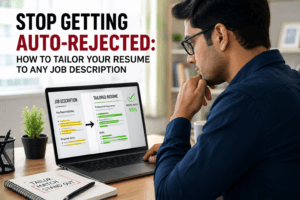
  • Resume Scoring and Enhancement The platform also analyzes your resume against industry standards, suggesting keyword optimizations that help you pass automated screening systems. By aligning your resume with the job description using JobUAI, you significantly increase your chances of getting shortlisted for the interview in the first place.
Online Interview Practice Guide 1

Body Language and Soft Skills

In a virtual setting, your body language is restricted to the upper body, making facial expressions and voice modulation even more important.

  • Voice Modulation and Pace Monotonous speaking can make even the most exciting achievements sound boring.
  • Varying Your Tone Practice speaking with energy and enthusiasm to keep the interviewer engaged throughout the conversation. Using a dynamic vocal range helps emphasize key points and conveys passion for the role, which is infectious even across a digital connection.
  • Controlled Pacing Nervousness often causes candidates to speed up, making them hard to understand and causing them to run out of breath. Consciously slow down your speech, take pauses between sentences, and breathe to appear more authoritative and thoughtful.
  • Non-Verbal Communication Cues Your silent signals speak volumes about your attentiveness and attitude.
  • Active Listening Signs Nod occasionally and smile when appropriate to show the interviewer that you are following their words and are interested in the discussion. These small gestures replace the “hmms” and “yeahs” that can clutter the audio channel and disrupt the flow of conversation.
  • Posture and Presence Sit up straight with your shoulders back to project confidence and alertness, avoiding the tendency to slouch or lean back in your chair. Good posture not only looks professional but also helps you breathe better, which improves your vocal projection and clarity.

Conclusion

Mastering the art of the online interview is a journey of continuous improvement. It requires a blend of technical reliability, strategic content preparation, and the ability to adapt to a digital format. Whether you are a student facing your first placement season or a professional aiming for the next rung on the corporate ladder, the principles remain the same. You must respect the medium, prepare thoroughly, and present the best version of yourself.

Tools like JobUAI have democratized access to high-quality interview coaching, allowing anyone with an internet connection to refine their skills. By leveraging such platforms, you move beyond guessing what the interviewer wants and start practicing with precision. Embrace the digital shift, prepare with intent, and walk into your next online interview with the confidence that you are ready to succeed.

Frequently Asked Questions (FAQs)

Q1: How can I reduce nervousness before an online interview?

Answer: The most effective way to reduce nervousness is through consistent practice with realistic simulations like mock interviews. deep breathing exercises minutes before the call can also help lower your heart rate and calm your mind physically. ensuring your technical setup is working perfectly well in advance removes a major source of anxiety. visualizing a successful conversation helps shift your mindset from fear to confidence.

Q2: Is it necessary to wear formal shoes for a video interview?

Answer: While the interviewer will likely never see your feet, wearing shoes completes your professional mindset and posture. dressing fully in formal attire prevents the psychological feeling of being casual or too relaxed. it serves as a mental switch that tells your brain it is time to perform professionally. however, if you are extremely uncomfortable, you may skip them as long as you do not stand up during the call.

Q3: What should I do if I do not know the answer to a technical question?

Answer: It is better to admit you do not know the answer than to try and bluff your way through it, which is easily detected. you can politely say that you are not familiar with that specific topic right now but explain how you would approach finding the solution. showing your problem-solving logic is often more valuable to interviewers than rote memorization. this approach demonstrates honesty and a willingness to learn.

Q4: How does JobUAI help with resume preparation?

Answer: JobUAI scans your resume and compares it against the job descriptions you are targeting to identify missing keywords. it provides a score and specific suggestions on how to rephrase your experience to better match industry requirements. this optimization helps your application get past automated tracking systems used by many large companies. it ensures your resume highlights the exact skills recruiters are searching for.

Q5: Can I use notes during an online interview?

Answer: You can keep small sticky notes near your camera for quick reference to key metrics or questions you want to ask. however, you should never read from them directly as it breaks eye contact and sounds unnatural. keep the notes brief and use them only as prompts if you get stuck. the goal is to have a natural conversation, not to deliver a scripted speech.

Online Interview Practice Guide for Students and Professionals | JobUAI