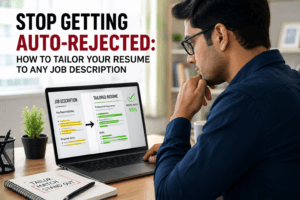

You’ve sent out application after application. Your resume has been updated. Every typo has been triple-checked. And yet — nothing. No callback. No interview invite. Just an inbox full of automated “thank you for applying” messages, or worse, complete silence. If your resume isn’t getting shortlisted, it’s not because you’re unqualified. In most cases, it’s because your resume is failing at a stage you never even knew existed.
The uncomfortable truth is that the vast majority of resumes are rejected before a single human being reads them. Between ATS filters, keyword gaps, formatting errors, and positioning mistakes, the modern hiring process is a gauntlet — and most candidates are walking into it unarmed.
In this guide, we’re going to pull back the curtain. We’ll cover the most common reasons your resume isn’t getting shortlisted, explain exactly what’s going wrong at each stage, and show you a clear, actionable path to fixing it — including how Jobuai’s ATS Aegis™ can diagnose and resolve these issues for you automatically.
The Two-Stage Rejection Nobody Talks About
Before we dive into specific fixes, you need to understand the modern hiring funnel — because most job seekers are operating with an outdated mental model of how it works.
When you submit a job application today, your resume doesn’t land on a recruiter’s desk. It lands inside an Applicant Tracking System (ATS) — software that automatically scans, parses, and ranks every application against a set of criteria defined by the job description. Only the top-scoring resumes ever get seen by human eyes.
Then, if your resume does survive the ATS filter, it faces a second cut: a recruiter spending an average of 6 to 7 seconds skimming it before deciding whether to move you forward. That’s two very different gatekeepers with two very different standards — and your resume needs to satisfy both.
Most candidates optimize for neither. Let’s change that.
9 Real Reasons Your Resume Isn’t Getting Shortlisted
1. Your Resume Is Failing the ATS Before Anyone Sees It
This is the number one silent killer of job applications. ATS software rejects over 75% of resumes before a recruiter ever reviews them — not because the candidates are unqualified, but because the resume format or content doesn’t parse correctly.
Common ATS failure points include:
- Multi-column layouts that confuse the parser’s reading order
- Contact information stored in headers or footers (invisible to most ATS engines)
- Tables, text boxes, and graphics that swallow your experience data
- Decorative or non-standard fonts that render as unreadable characters
- Image-based PDFs where no text can be extracted at all
The fix: Switch to a clean, single-column layout. Use standard fonts like Calibri or Arial. Place all contact details in the document body. Save as .DOCX or a text-based .PDF. Better yet, run your resume through Jobuai’s ATS Aegis™, which replicates exactly how leading ATS platforms parse your document and flags every structural issue instantly.
2. Your Keywords Don’t Match the Job Description

ATS systems work by comparing the language in your resume against the language in the job posting. If the terms don’t align, your match score drops — often below the threshold required to advance.
Here’s where most candidates go wrong: they use synonyms instead of exact matches. Writing “team coordination” when the job description says “cross-functional collaboration.” Writing “handled budgets” when they want “budget management”, These mean the same thing to a human — but not to an ATS.
Additionally, many candidates miss role-specific technical terms — software names, certifications, methodologies, and industry jargon that the ATS is specifically scanning for.
The fix: For every job you apply to, analyze the posting carefully and mirror its exact terminology in your resume. Make sure both abbreviated and full-form versions of key terms are present (e.g., “Project Management Professional (PMP)”). To simplify this process, Jobuai’s ATS Aegis™ performs an instant keyword gap analysis against any job description, showing you precisely what’s missing and where to add it.
3. You’re Using a Generic, One-Size-Fits-All Resume
Sending the same resume to every job opening is one of the costliest mistakes in modern job searching. Every job description is different, every company culture is different, and every ATS scoring algorithm is calibrated to that specific role.
A generic resume might be a 45% keyword match for a Marketing Manager role and a 38% match for a Brand Strategist role — even if both roles genuinely fit your background. In a competitive hiring pool, that gap is the difference between an interview and a rejection.
The fix: Treat every application as a unique submission. Customize your Professional Summary, your Skills section, and at least two or three of your experience bullets to reflect the specific language and priorities of each job posting. ATS Aegis™ makes this fast — it generates tailored optimization suggestions for each role in seconds, so customization no longer has to mean starting from scratch.
4. Your Professional Summary Isn’t Doing Its Job
The Professional Summary is the most strategically important section of your resume — and most people either skip it entirely or write a vague, generic paragraph that communicates nothing.
Statements like “Motivated professional with strong communication skills seeking a challenging opportunity” are resume filler. They don’t contain target keywords, they don’t differentiate you, and they waste the prime parsing real estate at the top of your document.
The fix: Write a focused 3–5 sentence summary that includes your job title, years of experience, 3–5 role-specific keywords, and one standout achievement or differentiator. Think of it as your elevator pitch for both the ATS and the recruiter who reads it.
5. Your Experience Bullets Are Responsibilities, Not Results
This is the mistake that kills otherwise strong resumes at the human review stage. Most candidates write their experience as a job description — a list of duties they were responsible for. What recruiters actually want to see is evidence of impact.
Compare these two bullets for the same role:
- “Responsible for managing the company’s social media accounts and creating content”.
- “Grew Instagram following from 4,200 to 31,000 in 10 months through a data-driven content strategy, increasing organic traffic to the website by 58%”.

The second version is richer in keywords, demonstrates measurable impact, and gives a recruiter a concrete reason to shortlist you. It also scores significantly higher in ATS systems that use NLP (Natural Language Processing) to assess experience relevance.
The fix: Rewrite every experience bullet using the Action Verb + Context + Measurable Outcome framework. If you don’t have exact numbers, use percentages, time savings, team sizes, or project scope to quantify impact.
6. Your Skills Section Is Either Missing or Misplaced
Many ATS platforms have a dedicated skills extraction module that specifically looks for a Skills section. If yours is buried or absent, The system can assign a lower competency score for skills that actually appear elsewhere in your resume.
Equally damaging is a Skills section that lists soft skills exclusively — “Team player”, “Detail-oriented”, “Good communicator”. These carry near-zero weight in ATS scoring. The system is looking for hard, verifiable skills: tools, technologies, methodologies, certifications.
The fix: Create a clearly labeled “Skills” section near the top of your resume. Populate it with a balanced mix of technical hard skills directly pulled from the job description, along with relevant soft skills where appropriate. Keep it scannable — a two-column list or comma-separated format works well for both ATS parsing and human readability.
7. Your Job Titles Don’t Match Industry Norms
Startups and fast-growing companies love creative job titles. “Ninja”, “Rockstar”, “Growth Hacker”, “Chief Happiness Officer” — they’re fun internally, but they’re resume poison externally.
When an ATS is programmed to find “Digital Marketing Manager” and your title says “Digital Growth Ninja”, the system simply doesn’t make the connection — and you get filtered out of a role you were genuinely perfect for.
The fix: Where your actual title differs from the industry-standard equivalent, add a parenthetical clarification: “Digital Growth Ninja (Digital Marketing Manager)”. This is honest, transparent, and ATS-compliant. Always check that your listed titles mirror the terminology used in your target job postings.
8. Your Resume Has Unexplained Gaps or Inconsistent Dates
Employment gaps are far less stigmatized in 2026 than they once were — but only if they’re handled correctly. An unexplained gap that an ATS flags as unusual can lower your profile score, and an unexplained gap that a recruiter notices without context triggers immediate skepticism.
Inconsistent date formatting also creates parsing errors. Using “Jan 2023 – Present” in one entry and “2021–2023” in another confuses the ATS’s tenure calculation algorithm, leading to inaccurate experience scoring.
The fix: Use a consistent date format throughout — “Month Year – Month Year” is the safest universal standard. For employment gaps longer than three months, add a brief explanation: freelance work, caregiving, education, health recovery, or professional development. Modern recruiters recognize and respect these explanations.
9. You’re Applying to the Wrong Roles (Or the Wrong Way)
Sometimes the resume isn’t the problem — the strategy is. Applying to roles where you meet fewer than 60% of the listed requirements, targeting the wrong level of seniority, or submitting through third-party aggregators that introduce additional ATS layers can all suppress your shortlisting rate.
Many candidates overlook the most powerful shortlisting tool available: referrals. A referred candidate is up to four times more likely to be shortlisted than a cold applicant, regardless of ATS score.
The fix: Apply to roles where you meet at least 70% of requirements. Where possible, apply directly through company career pages rather than aggregators. Invest time in building connections and seeking referrals — your network is the most reliable ATS bypass that exists.
The Shortlisting Problem Is Solvable — Meet ATS Aegis™
Working through this list manually is doable — but it’s time-consuming, technically nuanced, and easy to get wrong without the right tools. For every job you apply to, the optimization work needs to be repeated from scratch. That’s where Jobuai’s ATS Aegis™ changes everything.
ATS Aegis™ is Jobuai’s AI-powered resume defense engine, purpose-built to solve every shortlisting problem covered in this article — automatically and in real time. Here’s what it does:
- Full ATS Compatibility Audit: ATS Aegis™ parses your resume exactly as leading ATS platforms do, surfacing every formatting flaw, structural issue, and parsing risk before you submit — from hidden contact details to multi-column layout breaks.
- Real-Time Keyword Gap Analysis: Paste any job description and ATS Aegis™ calculates your current keyword match percentage, identifies every missing high-value term, and shows you exactly where and how to integrate them naturally.
- AI-Powered Rewrite Engine: Don’t just know what’s broken — fix it instantly. ATS Aegis™ generates contextually accurate, role-tailored rewrites for your Professional Summary, experience bullets, and Skills section.
- Section-by-Section Score Breakdown: See precisely how each section of your resume (Summary, Experience, Skills, Education, Formatting) scores against ATS benchmarks so you know where to focus your energy.
- One-Click Role Tailoring: Apply to a new role? ATS Aegis™ tailors your entire resume to the new job description in a single click — keyword alignment, bullet optimization, and formatting checks included.
- ATS-Safe Export: Download your optimized resume as a clean .DOCX or text-based .PDF, formatted perfectly for any ATS platform.
The result: instead of guessing why your resume isn’t getting shortlisted and hoping the next version performs better, you know — with precision — that you optimize your resume before submitting it
Upload your resume to ATS Aegis™ and find out your shortlisting score in under 60 seconds — free.

Quick Diagnostic: Is Your Resume Shortlist-Ready?
Run through this rapid self-audit right now. If you answer “No” to more than three of these, your shortlisting rate is being suppressed:
- Is your resume saved as a .DOCX or text-based .PDF?
- Is your contact information in the main document body (not a header/footer)?
- Does your resume use a single-column layout with no tables or text boxes?
- Have you tailored keywords to match this specific job description?
- Does your Professional Summary include your target job title and 3–5 role keywords?
- Are your experience bullets written as achievements (not duties)?
- Do you have a dedicated Skills section with hard, technical skills?
- Are your job titles aligned with standard industry terminology?
- Are all employment dates in a consistent Month Year format?
- Are you applying to roles where you meet at least 70% of requirements?
Stop Sending Resumes Into the Void
If recruiters aren’t shortlisting your resume, you now know it isn’t a reflection of your worth, your experience, or your potential. It’s a technical and strategic problem — and technical and strategic problems have solutions.
The job market in 2026 is more competitive than ever, and the ATS barrier is more sophisticated than most candidates realize. But the candidates who understand how the system works — and optimize accordingly — gain an enormous, compounding advantage over everyone else still applying blind.
You’ve just taken the first step by understanding what’s going wrong. Now take the second step: let ATS Aegis™ show you exactly how to fix it.
Get your free ATS shortlisting score — upload your resume now and see what’s really standing between you and the interview.
FAQ’S
A. Shortlisting and qualification are different. An ATS usually filters your resume first. Common issues include keyword mismatches, formatting errors, or a generic resume. Use Jobuai’s ATS Aegis™ to identify exact gaps.
A. Volume is not the answer if your resume has underlying optimization issues — you’ll simply accumulate more rejections. Fix the root problem first. Optimize your resume for ATS compatibility and keyword alignment, then apply strategically to roles where you meet 70%+ of requirements. A smaller number of well-targeted, optimized applications will always outperform a spray-and-pray approach.
A. Resume length itself doesn’t directly impact your ATS score — keyword density, relevance, and formatting do. However, for human reviewers, a concise and focused resume (one to two pages for most candidates) is easier to evaluate quickly. Padding a resume to fill space dilutes your keyword density and makes it harder for a recruiter to identify your value proposition in the 6–7 seconds they initially spend on it.
A. Many popular resume builders produce visually impressive documents that are actually terrible for ATS. They rely on tables, multi-column layouts, and design elements that break parsers. If you use a builder, make sure it explicitly generates ATS-compliant output. Jobuai’s platform lets you build, optimize, and test your resume against ATS scoring in one integrated workflow — so you get both a professional design and confirmed ATS compatibility.
A. With the right tools, faster than you’d think. A manual overhaul — restructuring, rewriting, keyword-optimizing — typically takes two to four hours per resume version. With Jobuai’s ATS Aegis™, the diagnosis takes under 60 seconds, and the AI-powered rewrite suggestions can reduce your total optimization time to 20–30 minutes per application. The key is having the right information upfront rather than guessing.